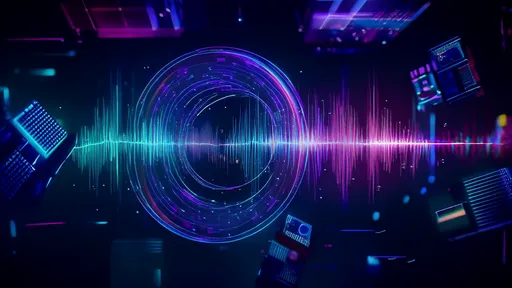
The world of audio technology has witnessed a fascinating resurgence in recent years with the growing interest in chip music waveform reconstruction. What began as a nostalgic revival of 8-bit and 16-bit soundtracks has evolved into a sophisticated field of study, blending retro aesthetics with cutting-edge signal processing techniques. Engineers and musicians alike are now exploring how to extract, analyze, and recreate the distinctive waveforms that defined early computer and video game soundtracks.
At its core, chip music relies on simple waveform generators—square waves, triangle waves, and pulse waves—produced by sound chips like the MOS Technology SID (Commodore 64) or the Ricoh 2A03 (Nintendo Entertainment System). These chips imposed strict limitations on polyphony and timbre, yet composers crafted remarkably expressive music within these constraints. Today, researchers are reverse-engineering these sounds not just for preservation, but to understand how their unique sonic qualities can inspire new musical tools and audio processing algorithms.
The process of reconstructing chip music waveforms involves both technical and artistic challenges. On the technical side, researchers must account for hardware quirks like filter nonlinearities, clock drift, and register artifacts that gave these chips their characteristic sound. Some teams are developing machine learning models trained on extensive databases of chip music to predict how particular sequences would have sounded on original hardware. Others are creating software emulations that go beyond mere playback, allowing for interactive manipulation of the synthesized waveforms.
What makes this field particularly exciting is its interdisciplinary nature. Audio engineers collaborate with vintage computing enthusiasts, while electronic musicians work alongside signal processing mathematicians. Together, they're developing new methods to analyze the harmonic content and temporal evolution of chip music waveforms. Some surprising discoveries have emerged—for instance, how certain combinations of simple waveforms can create psychoacoustic illusions of more complex timbres, or how the aliasing artifacts once considered limitations are now valued as distinctive musical features.
The applications of this research extend far beyond nostalgia. Game developers are incorporating authentic chip sounds into modern titles, while electronic musicians use waveform reconstruction techniques to create hybrid analog-digital instruments. Perhaps most intriguingly, some researchers are exploring how principles learned from chip music could inform the design of future audio compression algorithms or efficient synthesis methods for embedded systems. The humble sound chips of the 1980s may yet have lessons to teach us about creating rich auditory experiences with minimal computational resources.
As the field progresses, we're seeing increasingly sophisticated tools for chip music analysis and recreation. Some software can now take a raw audio recording of chip music and decompose it into its constituent waveforms and sequencing patterns. Other projects focus on interactive waveform editing, allowing users to morph between different chip sounds while maintaining authentic hardware behavior. The community surrounding this work includes not just researchers and professionals, but also a vibrant scene of hobbyists who share techniques and discoveries through online forums and dedicated conferences.
The cultural impact of this technological revival shouldn't be underestimated. Chip music has grown from a niche interest into a legitimate musical genre with its own festivals and record labels. Meanwhile, the techniques developed for waveform reconstruction are influencing broader electronic music production. Producers across genres now incorporate chip-style synthesis into their work, sometimes combining it with advanced effects processing to create sounds that bridge decades of technological development.
Looking ahead, the field of chip music waveform reconstruction faces interesting challenges and opportunities. One ongoing debate concerns the balance between authenticity and creative reinterpretation—should reconstructed chip sounds precisely mimic original hardware, or can they be enhanced for modern contexts? Another frontier involves developing standardized methods for preserving and documenting chip music creations, ensuring that this important chapter in audio history isn't lost to technological obsolescence. Whatever direction the field takes, it's clear that the simple waveforms of early sound chips continue to resonate through contemporary music and technology in surprisingly profound ways.
By /Aug 15, 2025

By /Aug 15, 2025
By /Aug 15, 2025

By /Aug 15, 2025
By /Aug 15, 2025
By /Aug 15, 2025
By /Aug 15, 2025

By /Aug 15, 2025

By /Aug 15, 2025

By /Aug 15, 2025
By /Aug 15, 2025
By /Aug 15, 2025

By /Aug 15, 2025

By /Aug 15, 2025

By /Aug 15, 2025

By /Aug 15, 2025

By /Aug 15, 2025

By /Aug 15, 2025

By /Aug 15, 2025

By /Aug 15, 2025